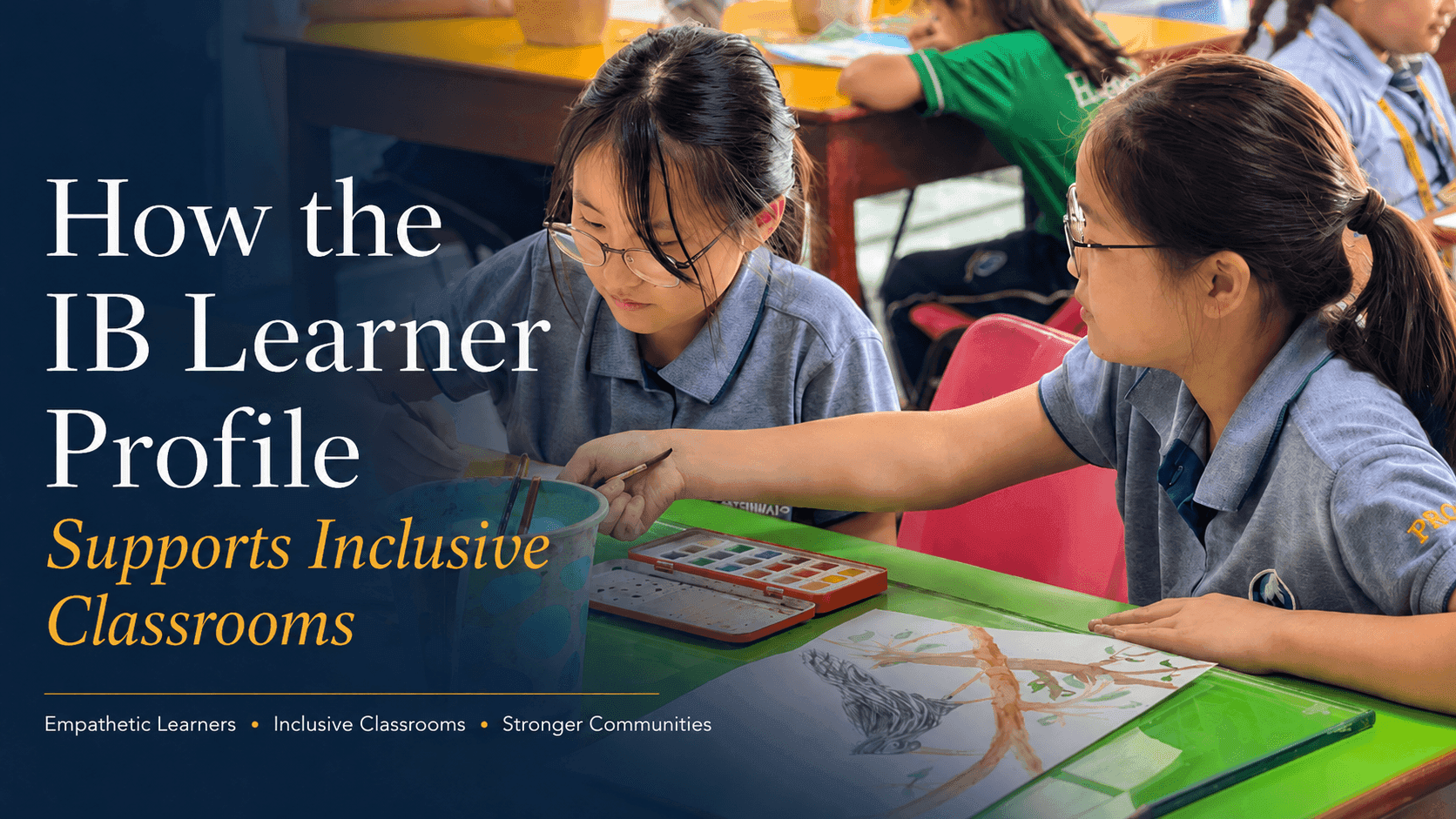
How the IB Learner Profile Supports Inclusive Classrooms
Pathways Team
Verified Author
Every child deserves to walk into a classroom feeling seen, valued, and ready to learn.
Yet the reality is that students arrive at school with different abilities, languages, cultural backgrounds, learning styles, and personal experiences. Building a classroom where every one of these children can truly thrive is one of the most important goals in modern education.
This is where the IB Learner Profile and inclusive classrooms connect so powerfully.
The International Baccalaureate (IB) doesn't just focus on academic achievement. It develops the whole child — nurturing qualities like empathy, open-mindedness, reflection, and respect. These are exactly the qualities that make a classroom inclusive.
In this blog, we explore how each of the 10 IB Learner Profile attributes actively supports an inclusive learning environment, and why this matters for every parent, teacher, and student.
What Is the IB Learner Profile?
The IB Learner Profile is a set of ten attributes that the International Baccalaureate aims to develop in all its learners. It sits at the heart of every IB programme — from the Primary Years Programme (PYP) through to the Diploma Programme (DP).
Rather than defining students by test scores, the Learner Profile describes the kind of person a well-rounded IB education aims to produce.
The ten attributes are:
Inquirers – Students who love learning and ask thoughtful questions
Knowledgeable – Students who explore important ideas across a range of disciplines
Thinkers – Students who think critically and solve problems creatively
Communicators – Students who express ideas confidently in many ways
Principled – Students who act with integrity and a strong sense of fairness
Open-minded – Students who appreciate different cultures and perspectives
Caring – Students who show empathy and compassion for others
Risk-takers – Students who approach new challenges with courage
Balanced – Students who take care of their physical, emotional, and academic wellbeing
Reflective – Students who think about their learning and how to improve
Together, these attributes create learners who are not only academically capable but also emotionally intelligent and socially responsible — which is precisely what an inclusive classroom requires.
What Makes a Classroom Inclusive?
An inclusive classroom is one where every student — regardless of their ability, background, language, culture, learning style, or confidence level — has equal access to learning, feels emotionally safe, and is encouraged to participate.
Inclusion is not about treating every child the same. It is about ensuring every child has what they need to succeed.
In an inclusive classroom, you will typically find:
Respect for individual differences and diverse perspectives
Access to learning for students with different needs and abilities
Active participation by all students, not just the most confident
Student voice — children are heard and their ideas are valued
Emotional safety — students feel comfortable making mistakes and asking questions
Differentiated learning — tasks are adapted to support different learning styles
Equal opportunity — no student is excluded or overlooked
Inclusive classrooms also celebrate diversity. They treat differences in culture, language, background, and ability not as obstacles but as genuine strengths.
How the IB Learner Profile Supports Inclusive Classrooms
Each of the 10 IB Learner Profile attributes plays a direct role in building and sustaining an inclusive classroom environment.
Inquirers
What it means: IB students are encouraged to ask questions, pursue their curiosity, and take ownership of their learning.
How it supports inclusion: When students are inquiry-led, learning is driven by genuine interest rather than a rigid, one-size-fits-all approach. This naturally accommodates different learning styles and paces.
Classroom example: A teacher asks students to investigate a local environmental issue. Students choose their own angle — some create visual displays, others write reports, and some build models. Every learner finds an entry point that suits them.
Knowledgeable
What it means: IB students explore significant ideas and content across a range of subjects, making connections between disciplines.
How it supports inclusion: When knowledge is drawn from multiple disciplines and contexts, students from different cultural backgrounds see their own experiences and histories reflected in what they learn. This is particularly important in diverse international school settings.
Classroom example: A history unit includes perspectives from African, Asian, and European civilisations — not just a Western viewpoint. Students from different backgrounds contribute personal or family context, enriching understanding for the whole class.
Thinkers
What it means: IB students develop critical thinking and creative problem-solving skills.
How it supports inclusion: Thinking tasks that are open-ended allow students with different abilities to engage at their own level. There is no single correct answer — every student's thinking is valued.
Classroom example: During a maths challenge, students are asked to find as many ways as possible to solve a problem. Students who struggle with one method discover another that works for them, building confidence alongside critical thinking skills.
Communicators
What it means: IB students express ideas and information confidently in more than one language and through multiple modes — written, spoken, visual, and digital.
How it supports inclusion: Students who are English language learners, or who find verbal communication challenging, are given alternative ways to demonstrate their understanding. Communication in IB classrooms is multimodal and multilingual.
Classroom example: A student who recently joined the school from another country presents their ideas through drawings and diagrams alongside limited written text. The teacher accepts and celebrates this contribution equally alongside more verbal responses.
Principled
What it means: IB students act with integrity, honesty, and a strong sense of personal ethics.
How it supports inclusion: A principled classroom is a fair and just one. Students learn to stand up against bullying, exclusion, and discrimination — making the learning environment safer and more respectful for everyone.
Classroom example: The class discusses a scenario where a student is left out of a group activity. Students reflect on fairness, what they would do, and how it would feel. This builds empathy and strengthens the classroom community.
Open-minded
What it means: IB students appreciate their own culture and the perspectives of others. They are willing to consider different viewpoints.
How it supports inclusion: Open-mindedness is perhaps the most directly inclusive of all the attributes. A class of open-minded learners embraces differences in culture, religion, ability, and experience — rather than fearing or dismissing them.
Classroom example: Students research festivals and traditions from classmates' home countries. The exercise builds respect and genuine curiosity about cultural differences, creating a more cohesive and welcoming classroom.
Caring
What it means: IB students show empathy, compassion, and respect for others. They act to make a positive difference.
How it supports inclusion: A caring classroom is one where no student is left isolated or overlooked. Students actively look out for each other — particularly those who may be struggling, whether academically, emotionally, or socially.
Classroom example: A class buddy system pairs confident students with those who are new or less settled. Over time, these relationships normalise support and create a sense of belonging for every child.
Risk-takers
What it means: IB students approach unfamiliar situations with courage and confidence. They learn from uncertainty and mistakes.
How it supports inclusion: For students who lack confidence — or who have previously experienced academic setbacks — a risk-taking culture removes the fear of failure. Mistakes are seen as part of the learning process, not a source of shame.
Classroom example: A shy student is encouraged to share an idea in a small group rather than in front of the whole class. Gradually, as the culture of safe risk-taking grows, the student builds the confidence to contribute more widely.
Balanced
What it means: IB students recognise the importance of balancing intellectual, physical, and emotional wellbeing.
How it supports inclusion: Inclusive classrooms acknowledge that students are whole human beings — not just academic performers. Balance ensures that emotional wellbeing, physical needs, and social development are given equal importance alongside academic progress.
Classroom example: A teacher notices a student appearing withdrawn and stressed. Rather than focusing only on academic performance, she checks in, adjusts the student's workload temporarily, and connects the family with the school's wellbeing support. The student feels seen and supported.
Reflective
What it means: IB students regularly think about their own learning what they understand, what they find difficult, and how they can improve.
How it supports inclusion: Reflection helps students develop self-awareness and take ownership of their learning journey. It also allows teachers to better understand how each student experiences lessons, making it easier to adapt and differentiate teaching.
Classroom example: At the end of each week, students complete a short reflection journal. One student writes that they learn best through visuals. The teacher uses this to adjust how she delivers content for that child — small change, significant impact.
Why Inclusive Classrooms Benefit Every Student
It is sometimes assumed that inclusive classrooms benefit only those students with additional needs. In reality, every student gains from learning in a diverse, inclusive environment.
Research consistently shows that inclusive classrooms lead to:
Greater confidence — students feel safe to take academic and social risks
Stronger empathy — exposure to different perspectives builds emotional intelligence
Better collaboration skills — working with diverse peers prepares students for real-world teamwork
Deeper respect for differences — students learn to value what makes others unique
Improved communication — practising different forms of expression strengthens overall literacy
More active participation — when every voice is valued, more students engage
A global mindset — students develop international mindedness that serves them well beyond school
Social and emotional growth — the whole child is supported, not just the academic side
Students educated in inclusive environments are consistently better prepared for diverse workplaces, communities, and global citizenship.
The Role of Teachers in Building Inclusive IB Classrooms
Teachers are the architects of inclusive learning environments. In IB schools, they are trained and supported to teach in ways that reflect the values of the Learner Profile.
Key approaches used by IB teachers to create inclusive classrooms include:
Differentiated instruction — adapting the same lesson so that students at different levels can all engage meaningfully with the content.
Student-centred learning — shifting the focus from teacher-led delivery to student inquiry, discussion, and exploration. This approach, sometimes called student-centred learning, allows children to engage at their own level.
Group activities — structured collaboration that brings together students with different strengths, helping them learn from one another.
Inquiry-based tasks — open-ended challenges with multiple valid responses, allowing every student to contribute meaningfully.
Safe discussion spaces — classroom norms where students are encouraged to share opinions respectfully, ask questions without embarrassment, and disagree constructively.
Regular reflection — building time into lessons for students to assess their own understanding and progress.
Respect for student identity — acknowledging and celebrating cultural backgrounds, home languages, and personal experiences as assets, not obstacles.
Support for learning diversity — including appropriate scaffolding for students with additional needs, language support for multilingual learners, and extension activities for students who need more challenge.
Why Parents Should Care About Inclusive IB Education
When parents choose a school, they are not just choosing a curriculum. They are choosing the environment in which their child will develop as a person.
Inclusive IB education prepares children for a world that is genuinely diverse in culture, ability, language, and perspective. Children educated in inclusive environments grow into adults who can collaborate across difference, lead with empathy, and communicate with clarity and respect.
For parents of children with different learning needs, inclusive IB classrooms offer the reassurance that their child will be supported not sidelined.
For parents of highly able children, inclusive classrooms offer richer collaboration and the opportunity to develop leadership, communication, and social skills alongside academic achievement.
And for all children, the experience of learning alongside peers from different backgrounds and with different strengths is an education in itself one that no textbook alone can provide.
The IB curriculum is built on the belief that education shapes not just what students know, but who they become. Inclusive classrooms are central to that belief.
Conclusion: Building Belonging Through the IB Learner Profile
The IB Learner Profile does not just describe academic skills. It describes human qualities empathy, open-mindedness, integrity, reflection, and care that are the very foundations of an inclusive classroom.
When students are inquirers, they explore learning in ways that work for them. When they are caring and open-minded, they create a community where everyone belongs. When they are reflective, they grow from experience. And when they are principled, they stand up for fairness and respect.
Together, these attributes don't just support IB learner profile inclusive classrooms — they build them, one interaction at a time.
Parents looking for a school that values academic growth and emotional development can explore how an IB learning environment supports every child. An inclusive education is not a compromise on excellence — it is excellence, fully realised.
Frequently Asked Questions
The IB Learner Profile is a set of ten attributes — including open-mindedness, empathy, and reflection — that IB programmes develop in all students. These qualities naturally support inclusive classrooms by encouraging respect for diversity, compassion for others, and learning approaches that accommodate different abilities and backgrounds.
IB schools use differentiated instruction, student-centred learning, and inquiry-based tasks to accommodate different learning styles, abilities, and languages. Teachers regularly reflect on and adapt their practice, and the Learner Profile attributes guide how students interact with and support one another.
In an international school education context, inclusive education means ensuring every student — regardless of nationality, language, learning ability, or cultural background — has equal access to learning, feels emotionally safe, and is actively supported to participate and grow.
Attributes such as open-mindedness and being knowledgeable encourage students to explore multiple perspectives and value different cultures. IB classrooms often include students from many nationalities, and teachers actively draw on this diversity to enrich discussion and deepen understanding.
The IB framework supports inclusive education by design. Its inquiry-based, student-centred approach allows for meaningful differentiation, and teachers are trained to adapt learning for students with a range of needs. Families considering IB schools should discuss specific support provisions as part of the school admission process.