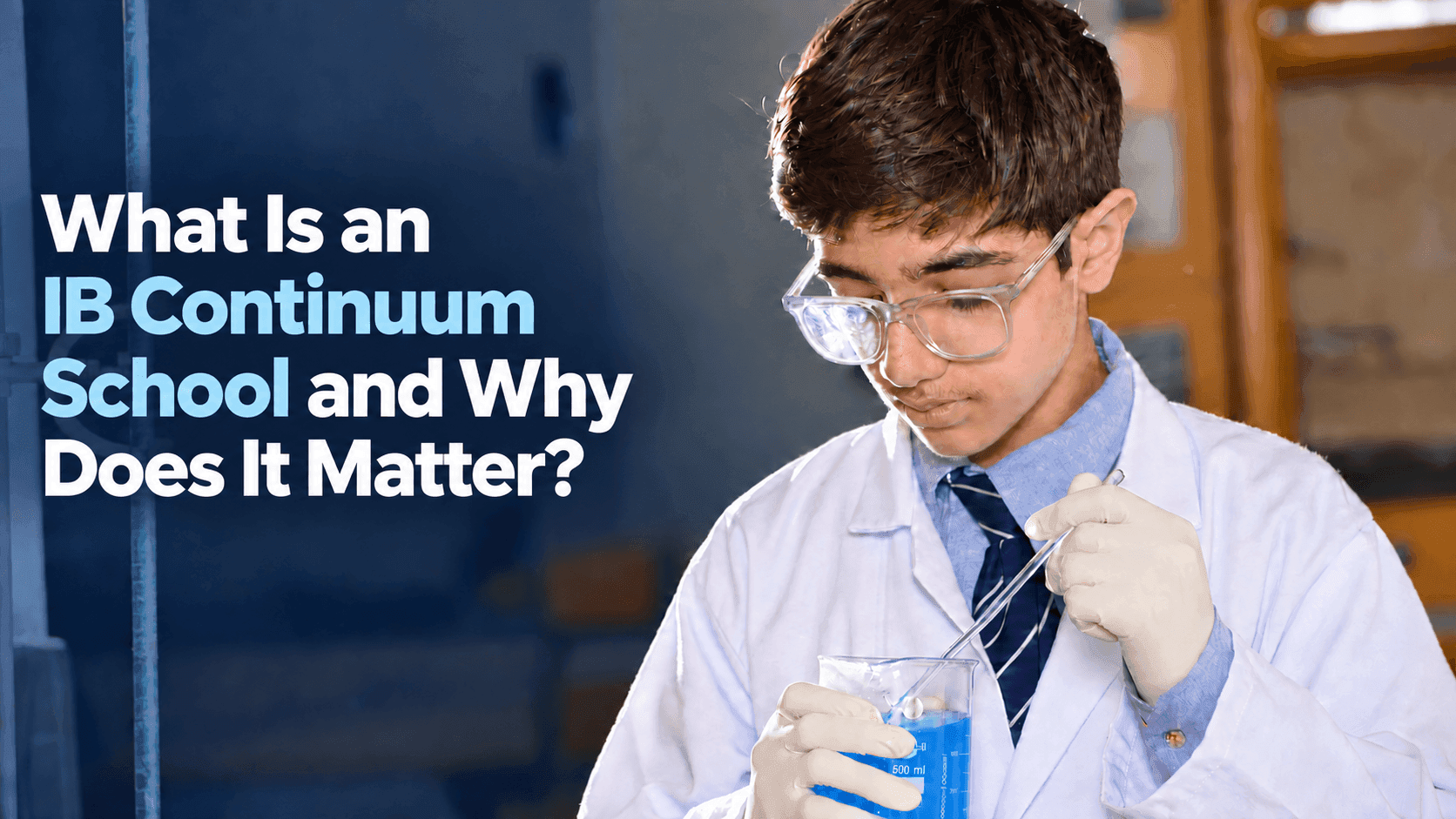
What Is an IB Continuum School and Why Does It Matter?
Pathways School Gurgaon
Verified Author
How do you choose a school that supports your child from their first classroom to their final board exams, without a jarring change of system midway? This is a common concern for parents researching long-term schooling options. An IB Continuum School is one answer.
An IB Continuum School is authorised to offer more than one International Baccalaureate (IB) programme, so students move through their education under one connected philosophy. Instead of switching curricula and teaching approaches at each stage, children experience continuity in how they learn, think and are assessed. This matters because confidence, learning habits and academic skills grow steadily when the surrounding environment stays consistent.
This article explains what an IB Continuum School means, how its programmes connect, and why this model matters for parents planning years in advance.
What Is an IB Continuum School?
An IB Continuum School is a school authorised by the International Baccalaureate to offer two or more IB programmes, creating a connected pathway from early childhood through to the final years of secondary school. It allows students to progress through consistent teaching approaches, shared learning values and a common assessment philosophy, rather than moving between unrelated systems.
Depending on their authorisation, IB Continuum Schools may offer:
The Primary Years Programme (PYP)
The Middle Years Programme (MYP)
The Diploma Programme (DP)
The Career-related Programme (CP), where relevant
Not every IB Continuum School offers all four programmes. Some are authorised for PYP and MYP only, while others extend through to DP or CP. Parents should confirm which programmes a school is authorised to deliver, since this varies by school.
Understanding the International Baccalaureate Continuum
The International Baccalaureate Continuum refers to the shared educational philosophy running across all IB programmes, regardless of a student's age. It rests on a few consistent ideas.
Inquiry-led learning: Students investigate concepts rather than only receiving information.
Conceptual understanding: Lessons are built around big ideas that connect subjects.
Critical thinking: Students analyse, question and evaluate rather than memorise.
Student agency: Learners take an active role in shaping their own exploration.
International-mindedness: Students engage with perspectives beyond their own culture.
Interdisciplinary learning: Subjects connect to real-world contexts rather than sitting in isolation.
Reflection and responsible action: Students reflect on learning and apply it meaningfully.
The IB Learner Profile: Ten attributes, such as being inquirers, thinkers and communicators, that IB programmes aim to develop at every age.
These principles do not change as a child advances. Only their depth and complexity increase, which is what makes the continuum feel connected rather than fragmented.
IB PYP, MYP and DP Explained
Each IB programme is designed for a specific age group and stage of development, while sharing the same underlying philosophy.
IB Programme | Typical Age Range | Educational Stage | Primary Focus |
|---|---|---|---|
Primary Years Programme (PYP) | 3–12 years | Early years to primary | Inquiry-based learning and the development of the whole child |
Middle Years Programme (MYP) | 11–16 years | Middle school | Interdisciplinary learning and real-world connections |
Diploma Programme (DP) | 16–19 years | Senior secondary | Academic depth, research skills and university preparation |
Career-related Programme (CP) | 16–19 years | Senior secondary | DP courses combined with career-related study, where offered |
Primary Years Programme (PYP)
The Primary Years Programme focuses on young learners exploring the world through structured inquiry. Children investigate questions across six transdisciplinary themes, building foundational knowledge alongside communication and collaboration skills. The emphasis is on curiosity, not rote learning.
Middle Years Programme (MYP)
The Middle Years Programme builds on this foundation with interdisciplinary study across eight subject groups. Students connect classroom learning to real-world issues and begin developing independent research skills, strengthening communication and reflective thinking.
Diploma Programme (DP)
The IB Diploma Programme is a rigorous two-year programme for students aged 16 to 19. It includes six subject groups alongside a core of Theory of Knowledge, the Extended Essay, and Creativity, Activity, Service (CAS), together deepening research skills and readiness for university-level study.
Where a school also offers the Career-related Programme (CP), it combines selected DP courses with career-focused learning, suited to applied and vocational interests.
How an IB Continuum Creates a Seamless Learning Pathway
An IB Continuum does not simply place three separate programmes next to each other. It links them through a shared philosophy, so skills built in one stage carry forward into the next.
Consistent teaching philosophy: Inquiry and conceptual learning stay central at every stage.
Gradual skill development: Research and inquiry skills grow in complexity rather than restarting.
Familiar assessment approaches: Students already understand how reflection and evaluation work.
Smoother academic transitions: Moving between stages feels like progression, not disruption.
Progressive independence: Students take on more self-directed learning over time.
Continuity in the Learner Profile: Attributes like being reflective and open-minded are reinforced consistently.
Reduced adjustment gaps: Less time is spent adapting to new expectations, more time building on existing ones.
Consider how inquiry develops across the continuum. In the PYP, a student might ask simple questions about their local environment. In the MYP, this evolves into structured research projects requiring evidence. By the DP, the same skill supports the Extended Essay, an independent research paper. The skill does not restart at each stage; it deepens.
Key Benefits of an IB Continuum School
Consistent Learning Philosophy Across Age Groups
Because every programme shares the same underlying approach, students are not asked to unlearn one method and adopt another as they grow older.
Strong Critical-Thinking and Problem-Solving Skills
Inquiry-based learning, practised early, helps students become comfortable analysing problems rather than memorising solutions.
Better Continuity During Academic Transitions
Moving between school stages happens within a familiar framework, which can reduce the stress of changing systems.
Development of Research and Communication Skills
Skills introduced in the PYP are reinforced and expanded in the MYP and DP, giving students repeated, structured practice.
Greater Student Ownership of Learning
Student agency is built into the IB philosophy from the earliest years, encouraging learners to take responsibility for their progress.
Interdisciplinary and Real-World Understanding
Subjects are consistently connected to real contexts, helping students see relationships between areas of knowledge.
Preparation for Higher Education
The research, writing and time-management skills built through the DP core are widely recognised as useful preparation for university-level study.
International Awareness and Cultural Understanding
International-mindedness is embedded throughout the continuum, helping students engage thoughtfully with different perspectives.
Balance Between Academic Achievement and Personal Growth
Programmes such as CAS in the DP, and similar service components earlier on, keep personal development alongside academic work.
IB Continuum School vs a School Offering Only One IB Programme
Both models can offer a strong IB education. The difference lies mainly in how learning connects across stages, not in the quality of either option.
Area | IB Continuum School | School Offering One IB Programme |
|---|---|---|
Programme continuity | Offers two or more linked IB programmes | Offers a single IB programme, often alongside other curricula before or after |
Teaching philosophy | Shared approach across all offered stages | Consistent within that programme, but may differ before or after it |
Transition between stages | Internal transitions within a familiar framework | May involve moving to a different school or curriculum system |
Skill progression | Builds progressively across programmes | Strong within the programme, but continuity outside it depends on the next school |
Familiarity with IB assessment | Consistent IB assessment approach throughout | Familiar only within the single programme offered |
Long-term learning pathway | Designed as one continuous journey | May require additional planning for what comes next |
A school offering only one IB programme is not automatically a weaker choice. Its value still depends on teaching quality, resources and how well it prepares students for their next academic step.
Why Does an IB Continuum School Matter to Parents?
Parents often worry whether their child will need to adjust to an entirely new system later in schooling. An IB Continuum School reduces this concern by keeping the underlying teaching philosophy consistent, even as academic demands increase.
Does learning go beyond memorisation? Inquiry-based, concept-driven teaching aims to build understanding rather than recall alone.
How are different developmental stages supported? Each programme is structured around the cognitive and social needs typical of that age group.
How do students gain independence without losing guidance? Scaffolding decreases gradually, while teacher support stays available at every stage.
How does the curriculum support future transitions? Research, reflection and communication skills are designed to prepare students for the next programme or external examinations.
Is this pathway suitable for internationally mobile families? Because the IB is taught in schools worldwide, a continuum pathway can offer some familiarity for families who relocate.
Is an IB Continuum Education Right for Every Child?
Not necessarily, and that is a fair question for parents to ask. An IB Continuum education tends to suit children who enjoy asking questions, working collaboratively and engaging in discussion-based learning.
Beyond the curriculum, parents should weigh several practical factors:
The child's individual learning preferences and pace
The experience and training of teachers delivering each programme
Student support systems, including learning support and counselling
The range of subjects available, particularly at DP level
The overall culture and values of the school
How assessment is structured and communicated to families
Extracurricular opportunities in sports, arts and other interests
The practicality of location and daily commute
Fees and long-term affordability across all stages
A strong curriculum framework is only part of the picture. How well a school implements it, through teachers, facilities and support systems, matters just as much as the programme label itself.
Choosing an IB Continuum School in Gurgaon
Parents comparing an IB school in Gurgaon, or evaluating IB schools in India more broadly, can use this checklist:
Which IB programmes is the school officially authorised to offer?
How does it connect learning between PYP, MYP and DP?
What training and experience do teachers have in delivering IB programmes?
How are students supported during transitions between programmes?
How does assessment work at each stage of the continuum?
What counselling and university guidance are available for senior students?
How does the school balance academics with arts, sports and wellbeing?
Can parents observe classrooms or speak with programme coordinators?
Where can the school's IB authorisation be independently verified?
Pathways School Gurgaon, an international school in Gurgaon, is one option parents may explore as part of this research. Its IB curriculum and campus and learning environment can be reviewed directly on the school's website. As with any school, it is worth confirming its specific programme authorisations and speaking with its admissions team to see how its approach fits your child's needs.
Conclusion
An IB Continuum School matters because it offers more than a set of qualifications; it offers a connected learning journey. When the PYP, MYP and DP share the same philosophy, students experience steady growth in inquiry, research and independence, rather than repeated adjustment to new systems.
Choosing the right school still depends on factors beyond the curriculum, including teaching quality, support systems and cultural fit. If you are exploring an IB Continuum School for your family, it is worth reviewing the IB learning pathway at Pathways School Gurgaon, checking its authorised programmes, and speaking with the admissions at Pathways School Gurgaon team.
Frequently Asked Questions
An IB Continuum School is a school authorised by the International Baccalaureate to offer two or more IB programmes, such as the PYP, MYP, DP or CP. This allows students to move through a connected educational pathway built on a shared teaching philosophy, rather than switching between unrelated systems at each stage of schooling.
The main IB Continuum programmes are the Primary Years Programme (PYP) for ages 3–12, the Middle Years Programme (MYP) for ages 11–16, the Diploma Programme (DP) for ages 16–19, and the Career-related Programme (CP), also for ages 16–19 where a school is authorised to offer it.
The PYP focuses on inquiry-based learning for young children, the MYP introduces interdisciplinary study and real-world connections for middle school students, and the DP is a rigorous two-year programme for older students that includes subject examinations, an Extended Essay and Theory of Knowledge. Each stage builds on skills developed in the previous one.
Benefits include a consistent teaching philosophy across age groups, progressive development of research and communication skills, smoother transitions between school stages, and continuity in values from the IB Learner Profile. These factors can reduce the disruption students often experience when changing curricula.
Not necessarily for every child, though many adapt well over time. It tends to suit learners who enjoy inquiry, discussion and collaborative work. Parents should also consider teaching quality, student support systems and overall school culture, since these affect a child's experience as much as the curriculum itself.
Parents can check a school's IB authorisation and the specific programmes it offers through the official International Baccalaureate website or its IB World Schools directory. It is advisable to confirm this information directly rather than relying solely on a school's own marketing materials.