From Robotics to Real-World Problem Solving:STEM at Pathways School Gurgaon
Pathways Team
Verified Author
The world your child will graduate into looks very different from the one you grew up in. Artificial intelligence is reshaping industries, automation is changing the nature of work, and the problems humanity faces — from climate change to healthcare — demand thinkers who can do more than memorise facts. They demand innovators.
This is precisely why STEM education at Pathways Gurgaon is not an add-on or an after-school club. It is woven into the very fabric of how students learn, think, and engage with the world around them. As India's first IB Continuum School, Pathways School Gurgaon has long understood that the future belongs to those who can ask the right questions — and build the answers.
What Is STEM Education and Why Does It Matter Today?
STEM education integrates Science, Technology, Engineering, and Mathematics into a connected, inquiry-driven learning experience. Rather than treating these as separate subjects, STEM teaches students to apply knowledge across disciplines to solve real-world problems — preparing them for careers in AI, medicine, data science, engineering, and beyond.
STEM is not simply a collection of four subjects. It is a mindset — a way of approaching problems with curiosity, evidence, and creative thinking. In the modern workplace, employers consistently report that the skills they value most are critical thinking, collaboration, adaptability, and digital literacy. These are not coincidentally the very skills that effective STEM learning builds.
According to the World Economic Forum, 65% of children entering primary school today will work in jobs that do not yet exist. For parents in Gurgaon looking at schools today, the question is not whether STEM matters — it is whether their child's school is genuinely equipped to deliver it.
STEM education equips students with transferable, future-ready skills that go far beyond any single career path.
STEM Education at Pathways Gurgaon
At Pathways School Gurgaon, STEM learning is not confined to a science laboratory or a single timetable slot. It is integrated across the IB curriculum — from the Primary Years Programme (PYP), where young learners build inquiry habits, through the Middle Years Programme (MYP), where students engage in interdisciplinary projects, to the Diploma Programme (DP) and Career-related Programme (CP), where STEM thinking meets real-world application.
The school's pedagogy is rooted in inquiry-based learning — students are not passive recipients of information. They ask questions, form hypotheses, design experiments, and reflect on what they discover. This approach, inspired by Dr Howard Gardner's theory of Multiple Intelligences, respects the fact that every child thinks differently and learns best when given the space to explore.
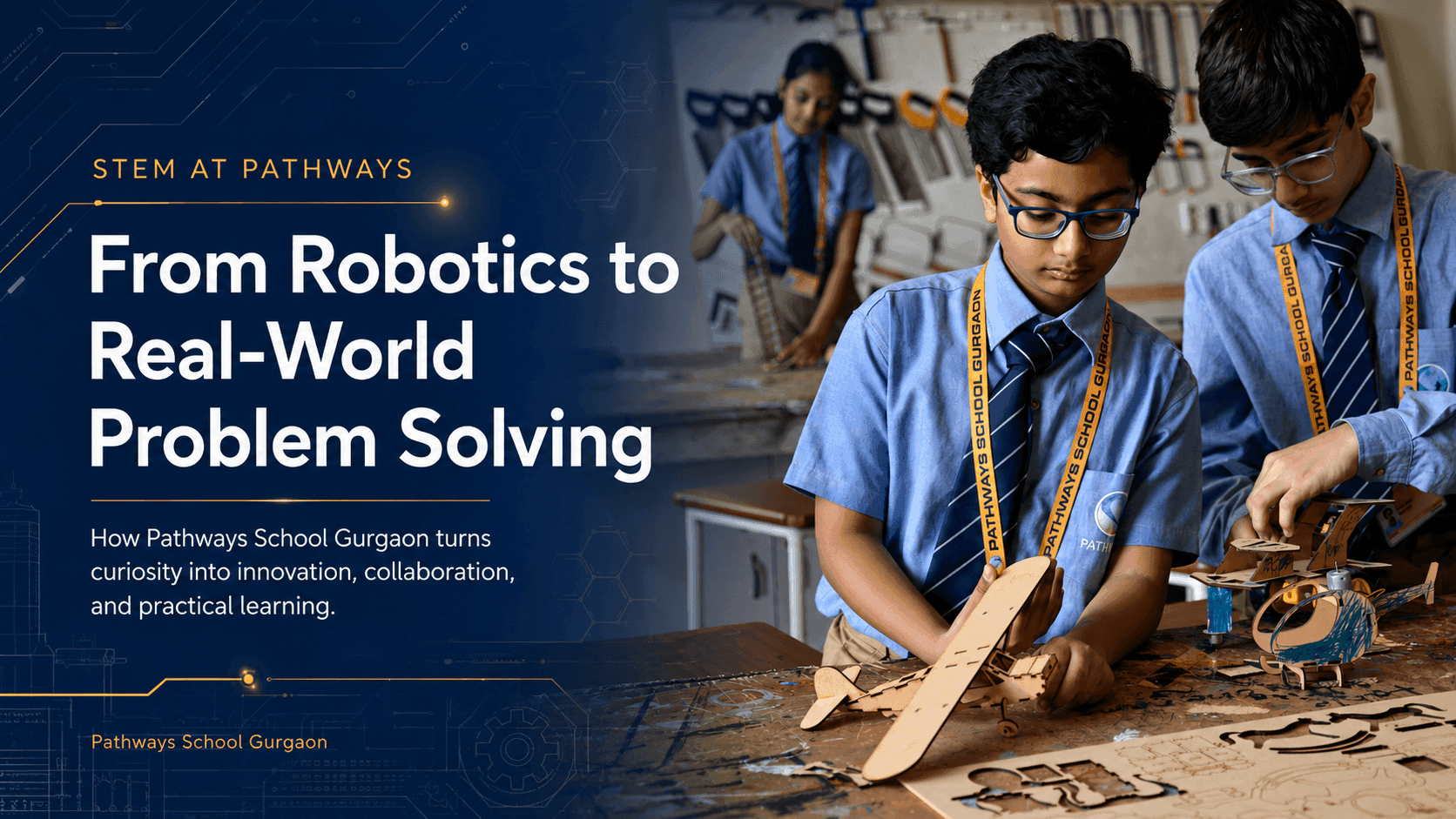
Design Technology is a dedicated subject at Pathways Gurgaon — an area where engineering principles, creative problem solving, and technical skill converge. Students move from identifying a real need, to designing a solution, prototyping it, testing it, and refining it. This is not textbook learning. This is thinking like an engineer.
STEM at Pathways Gurgaon is curriculum-wide, inquiry-driven, and grounded in the IB's ethos of holistic, student-centred education.
Robotics at Pathways Gurgaon — Learning Beyond Machines
Robotics education helps children develop computational thinking, coding skills, logical reasoning, and teamwork. By building and programming robots, students learn to break complex problems into manageable steps — a skill that transfers directly to engineering, data science, and technology careers.
Mention robotics to most parents and they picture a futuristic hobby. At Pathways School Gurgaon, robotics is a serious academic pursuit and one of the most powerful vehicles for developing the skills that matter most in the 21st century.
When students engage in robotics at Pathways Gurgaon, they are doing far more than assembling parts. They are:
Coding — writing and debugging programmes that bring their robots to life
Engineering — applying physics and mathematics to structural design
Collaborating — working in teams where each member's contribution is essential
Persisting — learning that failure is not the end but the beginning of better thinking
Presenting — communicating their design choices and outcomes to peers and teachers
This kind of hands-on, iterative learning builds what educators call design thinking — the ability to empathise with a problem, define it clearly, ideate solutions, prototype rapidly, and test relentlessly. It is the same process used by the engineers at ISRO, the developers at Google, and the surgeons designing the next generation of medical devices.
Robotics education at Pathways Gurgaon combines coding, engineering, and design thinking to develop confident, analytical problem-solvers.
From Classroom Concepts to Real-World Problem Solving
The most powerful STEM learning happens when students realise their work matters beyond the classroom walls. At Pathways School Gurgaon, project-based learning ensures that students consistently apply their knowledge to challenges that are real, relevant, and meaningful.
Students might investigate water quality in their local community and propose engineering solutions. They might design sustainable packaging for a local business, or programme a device to monitor air pollution. These are not hypothetical exercises — they are genuine applications of science, technology, engineering, and mathematics to problems that communities actually face.
This approach connects directly to the IB's commitment to global citizenship. Pathways students are encouraged to see themselves not just as learners, but as contributors — young people with the skills and the responsibility to make a positive difference in the world.
Collaborative learning experiences, both within classrooms and across year groups, teach students that the best solutions rarely come from a single brilliant mind. They come from diverse teams who communicate openly, challenge assumptions respectfully, and build on each other's ideas.
Real-world STEM learning at Pathways Gurgaon transforms students from passive learners into active problem-solvers who tackle genuine community and global challenges.
Key Skills Students Develop Through STEM Learning
STEM education at an international school like Pathways Gurgaon develops a rich portfolio of skills that employers and universities value highly:
Skill | How STEM Develops It |
Critical Thinking | Analysing data, evaluating evidence, and forming logical conclusions |
Creativity | Designing original solutions to open-ended problems |
Collaboration | Working in interdisciplinary teams with shared goals |
Communication | Presenting research, explaining design decisions, and debating ideas |
Problem Solving | Applying systematic approaches to complex, real-world challenges |
Digital Literacy | Using technology as a tool for research, creation, and innovation |
Adaptability | Iterating on failed designs and adjusting to new information |
Leadership | Taking initiative in group projects and guiding peers toward shared outcomes |
These are not soft skills that sit alongside academic learning. They are the core competencies that make an IB graduate genuinely employable, genuinely entrepreneurial, and genuinely equipped for a world we cannot yet fully predict.
STEM Education vs Traditional Learning
Traditional Learning | STEM-Based Learning | |
Approach | Subject-by-subject, siloed | Interdisciplinary and integrated |
Role of student | Passive recipient | Active investigator and creator |
Assessment | Primarily exams and memorisation | Projects, portfolios, presentations |
Problem type | Predefined, one correct answer | Open-ended, multiple valid solutions |
Failure | Penalised | Treated as a learning opportunity |
Real-world connection | Limited | Central to every lesson |
Skills developed | Content knowledge | Critical thinking, creativity, collaboration |
Technology | Supplementary | Integral to the learning process |
For parents weighing school choices, this comparison is not about dismissing academic rigour. Pathways Gurgaon maintains exceptional academic outcomes — its IB results speak for themselves. The point is that academic excellence and real-world capability are not in competition. At Pathways, they reinforce each other.
How STEM Activities Prepare Students for Future Careers
The careers your child may pursue are already taking shape — and they are overwhelmingly STEM-influenced. Consider the roles that are growing fastest globally:
Artificial Intelligence and Machine Learning — engineers and ethicists who design responsible AI systems
Biomedical Engineering — professionals at the intersection of biology and technology
Environmental Science — innovators developing solutions to climate and sustainability challenges
Data Science — analysts who turn information into decisions
Robotics and Automation — designers of the machines that will work alongside humans
Entrepreneurship — founders who identify problems and build technology-driven solutions
Digital Healthcare — doctors, technologists, and policymakers reinventing how medicine is delivered
What all of these careers share is a need for the thinking skills that STEM learning in Gurgaon — and specifically at Pathways — actively develops. Graduates of the IB Diploma Programme are already recognised by leading universities worldwide as exceptionally well-prepared forthese fields. When you add the depth of STEM integration at Pathways, you are giving your child a genuine head start.
STEM education does not lock children into a single career — it opens doors to dozens of the world's fastest-growing, most impactful fields.
The Pathways Gurgaon Advantage
Pathways School Gurgaon is not simply a school that offers STEM. It is a school built on the philosophy that education must prepare students for a world that is constantly changing.
As the #1 ranked international school in North India, Pathways offers:
The full IB Continuum — PYP, MYP, DP, and CP — a coherent, globally recognised pathway from early years to university entrance
A 13-acre LEED Platinum certified campus with state-of-the-art science and technology laboratories
Dedicated Design Technology facilities where students engineer, prototype, and build
A student-teacher ratio of 8:1 — ensuring every child receives personal attention and mentorship
A diverse community of 18+ nationalities that brings genuine global perspectives into every classroom
World-class accreditations from NEASC, CIS, and SAGE — benchmarked against the best schools internationally
A College Advisory programme that connects STEM learning to university applications and career planning from the MYP onwards
The school's green philosophy and sustainability focus also mean that students are already engaging with the environmental challenges that will define their professional lives — not as abstract issues, but as design problems they are actively working to solve.
Conclusion
The question is no longer whether STEM education matters. The evidence — from employer surveys to economic forecasts to the changing shape of every industry — is unambiguous. The real question for parents is: which school will genuinely equip my child with these skills, and not just talk about them?
STEM education at Pathways Gurgaon is not a programme bolted onto a traditional school. It is the natural expression of an educational philosophy built on inquiry, innovation, and the belief that every student has the capacity to be a problem-solver, a creator, and a contributor.
From the youngest learners in the Primary Years Programme to the diploma students designing solutions for real community challenges, every Pathways student is developing the mindset — and the skills — that the world urgently needs.
If you are looking for an international school in Gurgaon where your child will not just learn about the future but genuinely be prepared to shape it, we invite you to experience Pathways School Gurgaon for yourself.
Frequently Asked Questions
STEM education integrates Science, Technology, Engineering, and Mathematics into a connected, inquiry-driven curriculum. It teaches students to solve real-world problems using evidence, critical thinking, and creative design — developing skills that are essential for future careers in technology, medicine, engineering, and beyond.
STEM develops the skills — critical thinking, collaboration, digital literacy, and problem solving — that are most valued in the modern workplace. With 65% of today's children expected to work in jobs that don't yet exist, STEM gives students the adaptability and capability to thrive in any future career.
Robotics teaches children to code, engineer, and think computationally. It builds logical reasoning, teamwork, and persistence — because robots rarely work perfectly on the first attempt. The iterative process of building, testing, and improving is one of the most valuable learning experiences a student can have.
Pathways Gurgaon offers STEM learning through Design Technology, science laboratories, coding, robotics, and interdisciplinary project-based learning embedded across the IB curriculum. Students tackle real-world challenges related to sustainability, community needs, and emerging technologies.
Absolutely. STEM is not exclusively for students who plan to become engineers or scientists. The critical thinking, creativity, and collaboration skills that STEM develops are valuable in every field — from medicine and business to the arts and social sciences
STEM education builds the foundational skills — analytical thinking, technological fluency, problem solving — that underpin nearly every high-growth career sector, including AI, data science, environmental engineering, biomedical research, and entrepreneurship.