From Classroom to Creator Space: The Evolution of Learning Environments
Pathways Team
Verified Author
Walk into a school today, and you may not recognize it as a "classroom" in the traditional sense. Rows of desks facing a chalkboard are giving way to open, flexible spaces filled with laptops, robotics kits, design tools, and collaborative work zones. This shift reflects the ongoing evolution of learning environments — a movement away from passive listening toward active creation.
At Pathways School Gurgaon, this evolution isn't a distant idea — it's part of how we've built our campus and our approach to teaching. As technology advances and the demands of the real world change, schools are transforming into places where students build, experiment, and innovate rather than simply memorize and recite. This is the essence of moving from classroom to creator space, and it's reshaping education at every level.
In this blog, we'll explore what this evolution means, why it matters, and how future-ready learning environments are preparing students for a world that values creativity as much as knowledge.
What Is the Evolution of Learning Environments?
The evolution of learning environments refers to the gradual transformation of physical and digital learning spaces — from rigid, lecture-based classrooms to flexible, technology-enabled, student-centered spaces designed for creativity and collaboration.
In simple terms, it's the shift from "learning by listening" to "learning by doing." Instead of a single teacher delivering information to rows of silent students, modern learning environments encourage exploration, teamwork, and hands-on problem-solving.
This evolution has been driven by several factors:
Advances in classroom technology and digital tools
A growing understanding of how children actually learn
The need for 21st-century skills in the workplace
Increased access to devices, software, and online platforms
Together, these forces are pushing schools to redesign not just their teaching methods, but their physical spaces too — something reflected in our own 13-acre campus infrastructure, built to support exactly this kind of learning.
From Traditional Classrooms to Student-Centered Learning Spaces
Traditional classrooms were built around one central idea: the teacher is the primary source of knowledge, and students absorb information through listening and note-taking. This model worked for decades, but it has clear limitations in today's fast-changing world.
Student-centered learning spaces flip this model. Instead of the teacher standing at the front delivering a one-way lecture, students take a more active role in their own learning. Teachers become facilitators and guides rather than the sole authority in the room.
Key differences include:
Flexible seating instead of fixed rows, allowing group work and movement
Project-based learning instead of only textbook-based instruction
Collaborative learning platforms instead of isolated individual tasks
Choice and voice in how students demonstrate understanding
This shift doesn't mean teachers matter less — it means their role has evolved to support curiosity, critical thinking, and independent problem-solving. It's central to our own pedagogy, which draws on the Multiple Intelligences approach to help every student learn in the way that suits them best.
What Is a Creator Space in Education?
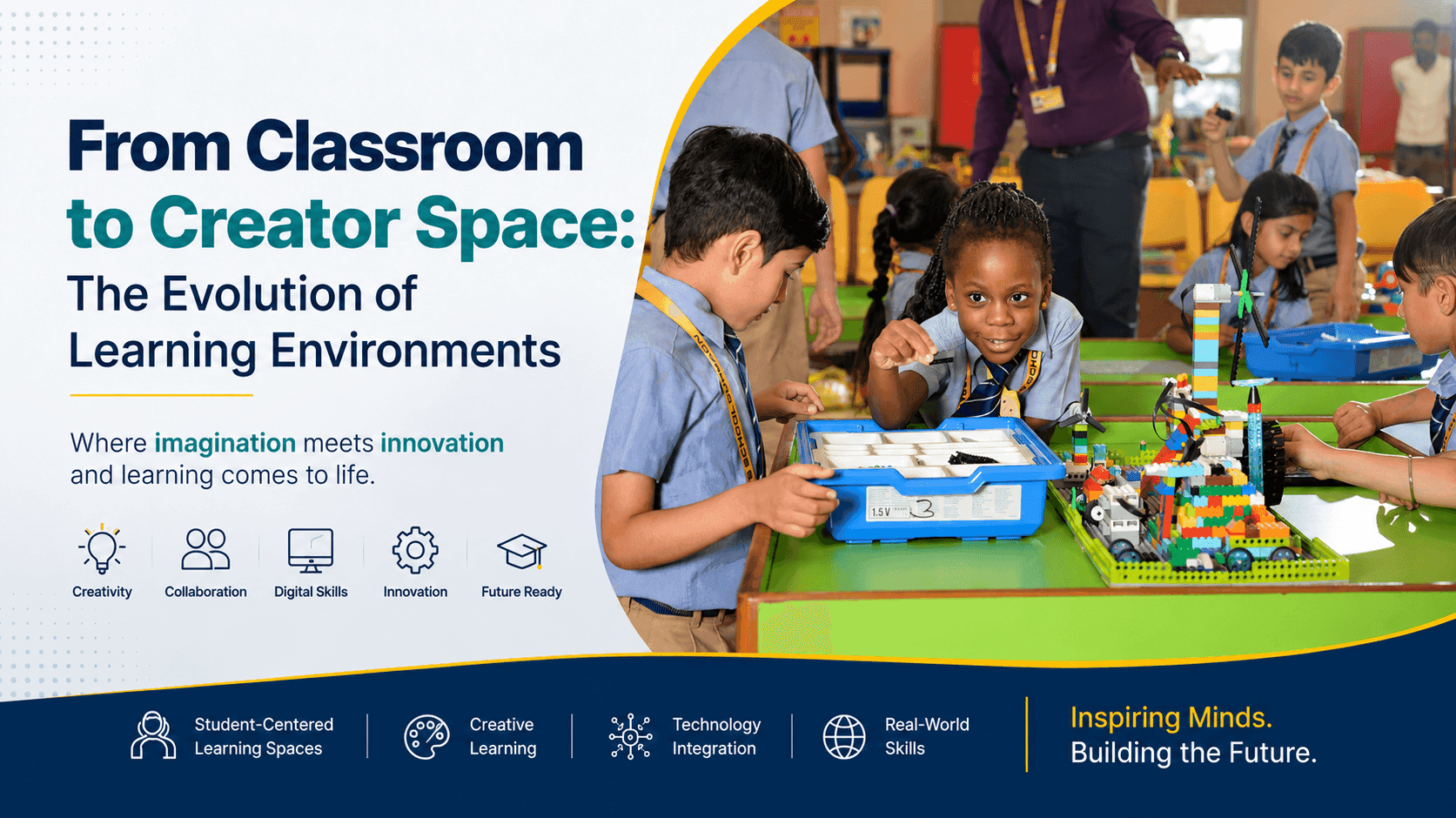
A creator space in education (also called a makerspace) is a dedicated area within a school where students can design, build, experiment, and bring ideas to life using tools like 3D printers, robotics kits, coding platforms, cameras, and design software.
Unlike a traditional classroom, a creator space is built around one core idea: learning happens best when students make something real. Whether it's a coding project, a robotics model, or a short film, creator spaces give students hands-on opportunities to apply what they've learned.
Creator spaces matter for modern schools because they:
Bridge the gap between theory and practical application
Encourage experimentation without fear of failure
Support interdisciplinary learning (combining art, science, technology, and design)
Prepare students for careers that value innovation and problem-solving
In short, a creator space turns students from passive recipients of information into active builders of knowledge — a philosophy you can see reflected in our Design Technology programme, where students prototype, test, and refine their own ideas.
Role of Technology in Modern Learning Environments
Technology is the backbone of the modern classroom's transformation. From smart classrooms to AI-powered tools, digital innovation is redefining how students engage with content.
Smart Classrooms and Digital Boards
Smart classrooms use interactive digital boards, connected devices, and real-time data to make lessons more engaging and adaptive. Instead of static presentations, teachers can pull in videos, simulations, and live collaboration tools within seconds.
AI Tools and Personalized Learning
AI tools are helping teachers personalize instruction based on each student's pace and learning style. This means struggling students get extra support, while advanced learners can move ahead with enrichment activities — all within the same classroom.
Coding and Robotics
Coding and robotics programs teach students logical thinking, sequencing, and problem-solving through direct, hands-on practice. Building a robot or writing a simple program helps students understand abstract concepts in a concrete, memorable way.
Collaborative Learning Platforms
Digital platforms allow students to co-create documents, share feedback, and work on group projects in real time — even outside school hours. This builds communication and teamwork skills alongside technical competence.
Together, these tools are creating a true digital learning environment, where technology isn't a distraction but a core part of how students think, create, and collaborate. Explore how we bring this to life through our own approach to technology in education.
Why Modern Classroom Design Matters
Physical space has a direct impact on how students think and learn. Modern classroom design focuses on flexibility, comfort, and functionality rather than uniformity.
Well-designed learning spaces typically include:
Movable furniture that supports group work and quick reconfiguration
Zones for different activities — quiet reading corners, collaborative tables, maker areas
Natural light and open layouts to improve focus and wellbeing
Integrated technology built into the room rather than added as an afterthought
When classrooms are designed thoughtfully, students feel more comfortable exploring ideas, asking questions, and working with peers. Design isn't just aesthetic — it directly shapes behavior, engagement, and learning outcomes. You can experience this firsthand through our virtual campus tour, which showcases how every space on campus is designed with learning in mind.
Benefits of Future-Ready Learning Environments
Future-ready learning environments are spaces intentionally designed to prepare students for the skills, technologies, and challenges of tomorrow — not just today's curriculum.
The core benefits include:
Stronger 21st-century skills — creativity, communication, collaboration, and critical thinking
Greater digital literacy through consistent exposure to relevant tools and platforms
Improved problem-solving ability from hands-on, project-based challenges
Better preparation for future careers, many of which don't exist yet
Increased student engagement and motivation due to more active, meaningful learning
Schools that invest in future-ready environments are essentially investing in adaptability — helping students become learners who can thrive amid constant change. This is one of the reasons our IB curriculum, spanning the PYP, MYP, DP, and CP, places such strong emphasis on inquiry, reflection, and real-world application.
How Creative Learning Spaces Build Real-World Skills
Creative learning spaces allow students to apply classroom concepts to real, tangible projects. This is where theoretical knowledge turns into practical capability.
Examples of this in action include:
Coding projects that teach logic, patience, and structured thinking
Robotics models that combine engineering, math, and teamwork
Video creation that builds storytelling, editing, and communication skills
Storytelling and creative writing that strengthen expression and imagination
Science experiments that develop observation, hypothesis-testing, and analysis
Design prototypes that encourage iteration and creative problem-solving
Group presentations that build public speaking and leadership confidence
Each of these activities does more than teach a subject — it builds transferable skills students will use throughout their lives. Our students explore many of these skills through dedicated spaces for visual arts and performing arts, alongside sports facilities that build teamwork and resilience through sports.
Why Schools Need Creator Spaces Today
The world students are entering values innovation, adaptability, and practical skills far more than rote memorization. Innovation in education isn't optional anymore — it's essential for preparing students to compete and contribute meaningfully.
Creator spaces help schools:
Stay aligned with modern workforce expectations
Support diverse learning styles beyond traditional instruction
Give students a safe space to fail, iterate, and improve
Foster genuine curiosity and a love of learning
For parents and school leaders, investing in creator spaces signals a commitment to preparing students not just for exams, but for life — and for the pathways students choose after school, supported by our college advisory team.
The Future of Learning Environments
Looking ahead, learning environments will likely become even more personalized, flexible, and technology-integrated. We can expect to see:
Greater use of AI-driven personalized learning paths
Expansion of hybrid and blended learning models
More interdisciplinary creator spaces combining art, science, and technology
Increased emphasis on soft skills alongside technical competencies
The evolution of learning environments is an ongoing journey, not a one-time change. Schools that continue adapting — combining thoughtful design, purposeful technology, and student-centered teaching — will be best positioned to prepare students for whatever the future holds.
Conclusion
The shift from classroom to creator space marks one of the most significant developments in modern education. This evolution of learning environments reflects a deeper understanding of how students truly learn: through doing, creating, collaborating, and exploring.
For educators, parents, and school leaders, embracing this shift means more than upgrading furniture or adding devices — it means reimagining education itself to be more engaging, practical, and future-ready. At Pathways School Gurgaon, this philosophy shapes everything from our curriculum to our campus design. If you'd like to see how our learning environments bring these ideas to life, explore our admissions process and discover what makes Pathways a future-ready school for your child.
Frequently Asked Questions
Technology plays a central role by enabling smart classrooms, AI-driven personalized learning, coding, robotics, and collaborative digital platforms. It supports more engaging, adaptive instruction, allowing teachers to tailor lessons to individual student needs while building essential digital skills.
Future-ready learning environments prepare students for careers and challenges that don't fully exist yet. By building skills like creativity, collaboration, digital literacy, and critical thinking, these spaces help students adapt to rapid technological and workplace changes throughout their lives.
Classrooms are evolving through flexible furniture, integrated technology, and project-based activities that replace fixed seating and lecture-only formats. Schools are adding maker tools, digital boards, and collaborative zones, allowing students to actively build, create, and problem-solve instead of simply listening and taking notes.
The evolution of learning environments refers to the transformation of classrooms from traditional, teacher-led spaces into flexible, technology-enabled, student-centered environments. It reflects a shift toward hands-on, collaborative learning that prepares students for real-world skills rather than focusing solely on memorization and passive instruction.
Creative learning spaces let students apply concepts through hands-on projects like coding, robotics, storytelling, and design prototypes. This practical approach strengthens problem-solving, communication, and critical thinking skills, while making learning more engaging, memorable, and relevant to real-world situations.