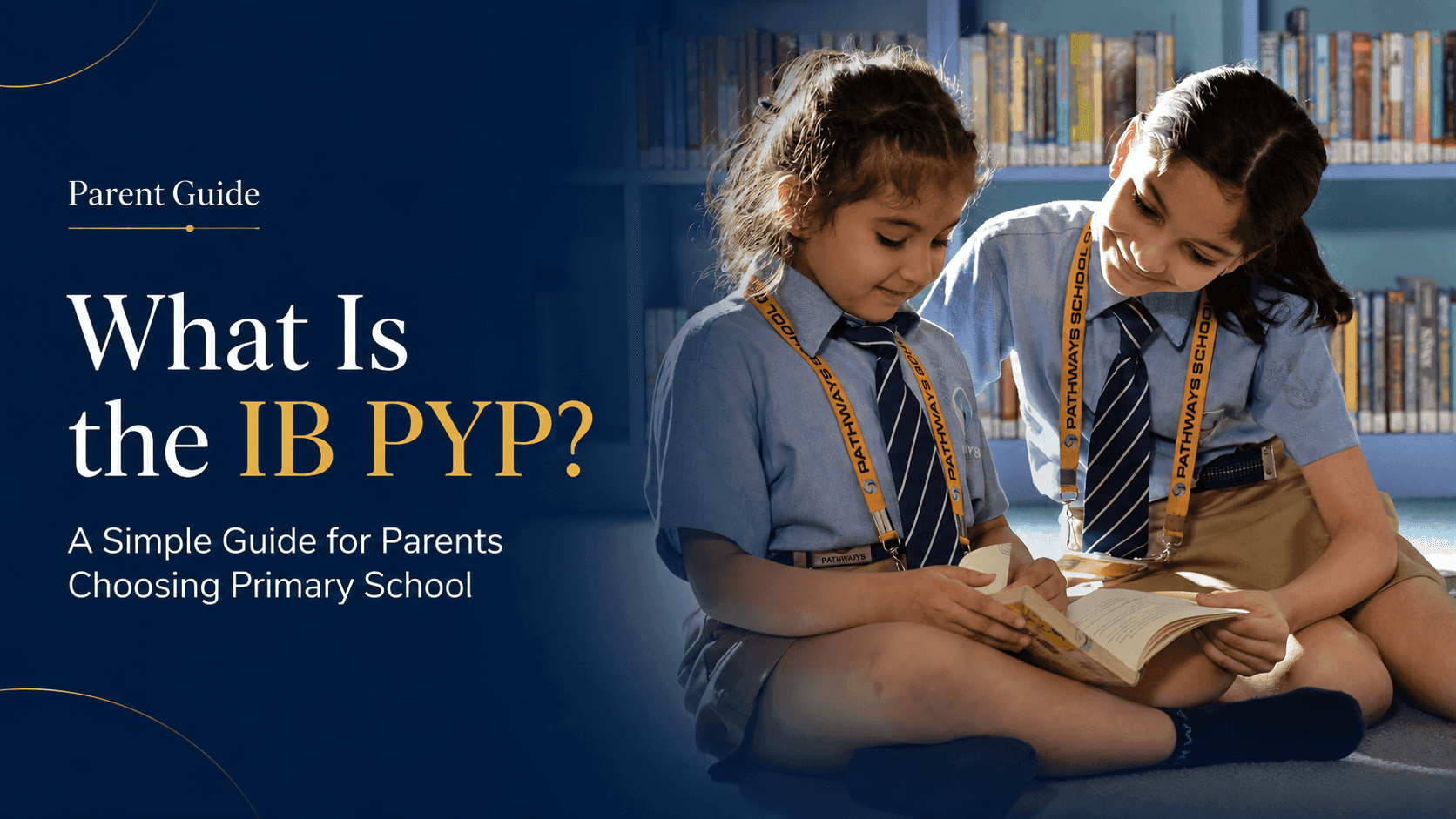
What Is the IB PYP? A Simple Guide for Parents Choosing Primary School
Pathways Team
Verified Author
If you've started researching primary schools, you've probably come across the term IB PYP more than once. Along with it come phrases like inquiry-based learning, student agency, and international curriculum — words that sound important but aren't always explained in plain language.
This guide breaks down what the IB Primary Years Programme actually means, how it works day to day, and what it looks like for a child sitting in a primary school classroom. The aim is simple: help you understand the programme clearly enough to decide whether it fits your child, without the jargon.
What Is the IB PYP?
The IB PYP (Primary Years Programme) is a curriculum framework developed by the International Baccalaureate (IB) for children aged 3 to 12. It focuses on developing children as curious, confident learners through inquiry and conceptual understanding, rather than centring lessons purely around textbook content.
PYP stands for Primary Years Programme. It's the earliest of the IB's four education programmes, designed to prepare children for the IB Middle Years Programme later on. Schools that offer the full IB continuum typically design the PYP years as the foundation for this longer academic journey.
Rather than treating each subject as a separate, isolated block, the PYP encourages children to explore big ideas that connect across subjects. A unit on "how the world works," for example, might weave together science, language, and maths within a single line of inquiry. The underlying philosophy is that children learn best when they understand why something matters, not just what the answer is.
How Does the IB PYP Curriculum Work?
The PYP curriculum is built around a few core ideas working together: inquiry, concepts, and real-world connections.
Rather than following a rigid sequence of chapters, teachers design units of inquiry — structured explorations of a central idea. A unit might centre on a concept like "communities" or "change," and children investigate that idea through questions, discussion, hands-on activities, and research.
Teachers still play an active role. They introduce vocabulary, model skills, correct misunderstandings, and provide direct instruction where needed. What changes is the balance: children are expected to participate, ask questions, and make connections, rather than simply listen and repeat. Schools often describe their overall approach to this balance through their teaching pedagogy, which is worth reviewing alongside the curriculum itself.
In practice, this might look like:
A maths lesson where children investigate patterns in a local market's pricing before being taught the formal concept of ratio.
A science topic on plants that starts with children's own questions about why leaves change colour, rather than a definition handed to them first.
What Is Inquiry-Based Learning in IB PYP?
Inquiry-based learning is one of the terms parents hear most often, and it's easiest to understand by comparing it with a more traditional classroom.
Traditional approach: the teacher explains a topic, students memorise the information, and students later reproduce it in a test.
Inquiry-based approach: students ask questions about a topic, investigate using books, experiments, or discussion, test their ideas, connect what they find to concepts they already know, and then communicate their understanding to others.
This doesn't mean PYP classrooms have no direct teaching. Teachers still guide the process closely — setting up the investigation, asking probing questions, and stepping in with explanations when children need them. The difference is that children are doing more of the thinking themselves, with the teacher structuring the experience rather than simply delivering facts.
What Is Concept-Based Learning in the PYP?
Concept-based learning means children are taught to understand broad, transferable ideas rather than memorising isolated facts that are easily forgotten.
Take the topic of water. In a fact-based lesson, a child might learn the boiling point of water and move on. In a concept-based PYP unit, the same topic might be used to explore bigger ideas such as:
Change (how water shifts between states)
Systems (how water moves through an ecosystem)
Responsibility (how communities manage water use)
Cause and effect (how pollution affects water quality)
The advantage of this approach is transfer. A child who understands "systems" as a concept can apply that thinking to a completely different topic later — from the human body to a city's transport network — rather than starting from zero each time.
What Do Children Learn in the IB PYP?
Learning in the PYP happens across recognisable subject areas, including:
Language
Mathematics
Science
Social studies
Arts
Personal, social, and physical education
What sets the programme apart is how these areas connect. Units of inquiry are often transdisciplinary, meaning a single topic draws on more than one subject at once, rather than each subject living in its own separate lesson slot. Exactly how this plays out — the balance of standalone subject lessons versus blended units — can vary from school to school, so it's worth asking a specific school how it structures its week, and how it supports children who may need extra help along the way through dedicated learning support provisions.
What Skills Does IB PYP Help Children Develop?
Beyond subject content, the PYP places deliberate emphasis on skills children will use well beyond the classroom.
Critical thinking — evaluating information rather than accepting it at face value, built through open-ended questions and problem-solving tasks.
Communication — expressing ideas clearly, practised through presentations, discussions, and written reflection.
Research — finding, organising, and using information, developed through guided inquiry projects.
Collaboration — working effectively with others, built into group investigations and shared tasks.
Self-management — organising time and effort, encouraged through student-led project work.
Reflection — thinking about one's own learning, often built in through journals or discussion at the end of a unit.
These skills are woven into everyday classroom activities rather than taught as separate lessons.
What Is Student Agency in IB PYP?
Student agency refers to a child's voice, choice, and ownership over their own learning. It does not mean children decide everything themselves or that the classroom lacks structure.
In practice, agency might mean a child choosing how to present a project — as a poster, a short presentation, or a model — within a set of options the teacher has defined. Teachers create these age-appropriate choices deliberately, within a clear structure, so children build responsibility and independence gradually rather than being left without guidance.
How Are Students Assessed in IB PYP?
Assessment in the PYP is continuous rather than resting on a single exam. Common methods include:
Teacher observation during lessons
Projects and presentations
Classwork and written tasks
Student reflection and self-assessment
Portfolios of work, where a school uses them
Ongoing feedback rather than only end-of-term marks
Individual schools may also use formal assessments alongside these methods. The key difference from a more traditional model is emphasis: PYP assessment aims to check understanding as it develops, not only measure how much a child can recall on a single test day.
What Are the Main Benefits of IB PYP?
Based on how the programme is designed, IB PYP is intended to:
Encourage curiosity through open-ended inquiry
Develop conceptual understanding that can transfer to new situations
Build communication skills through regular discussion and presentation
Promote independent thinking within a structured environment
Connect subjects to real-world contexts
Encourage collaboration through group-based tasks
Support the development of international-mindedness
Build habits of reflection and self-management
Prepare students for further inquiry-based learning in the IB Middle Years Programme
These are intended outcomes of the framework rather than guarantees. How well they show up in practice depends heavily on the individual school and its teachers.
IB PYP vs Traditional Primary Education
Area | IB PYP | More Traditional Approach |
|---|---|---|
Learning style | Inquiry and exploration | More teacher-led |
Curriculum | Concept-based | Often subject/content-based |
Student role | Active participant | Often more directed |
Assessment | Multiple ongoing forms | Greater emphasis may be placed on tests |
Subject connections | Interdisciplinary | Subjects often taught separately |
Skills focus | Thinking, communication, research, self-management | Often greater focus on content mastery |
Neither approach is universally "better" — they simply prioritise different things, and different children respond differently to each.
IB PYP vs CBSE: What Should Parents Understand?
Parents in India often compare IB PYP with CBSE, one of the country's most widely followed boards. At a broad level:
Curriculum philosophy: CBSE follows a structured, subject-wise syllabus set nationally, while IB PYP uses a concept-based, transdisciplinary framework that individual schools adapt.
Teaching methods: CBSE classrooms often lean toward direct instruction and textbook-based learning; PYP classrooms build in more inquiry and student-led investigation.
Assessment: CBSE places significant weight on periodic written exams; PYP relies more heavily on continuous, varied assessment.
International perspective: IB PYP is designed and used across many countries with a deliberate focus on international-mindedness; CBSE is designed primarily around the Indian national context.
Neither curriculum is inherently superior. A child's actual experience depends heavily on the specific school, its teachers, class sizes, and how well the curriculum is implemented — not the curriculum label alone.
Is IB PYP Suitable for Every Child?
Children who enjoy asking questions, exploring topics through hands-on tasks, working in groups, and connecting ideas to real situations often respond well to the PYP's inquiry-driven style.
That said, some children — especially those who feel more confident with clear, step-by-step instruction — may need extra support adjusting to a more open-ended classroom. This isn't a fixed trait; it usually depends on how well a particular school scaffolds inquiry for children who need more structure.
Rather than asking "is IB PYP good for children" in general, it's more useful to ask how a specific school supports different learning styles within the programme.
How to Choose the Right IB PYP School
The IB label alone doesn't guarantee a strong experience. Before enrolling, it helps to evaluate:
The school's official IB authorisation status
Teacher training and experience with the PYP
Levels of individual attention and student-teacher interaction
How the classroom environment is set up for inquiry
How assessment and feedback are communicated to parents
Learning support available for children who need it
Facilities that genuinely support hands-on, inquiry-based work
Overall school culture and student wellbeing
Opportunities available beyond academics
A campus visit, rather than a prospectus alone, usually reveals far more about how the programme actually runs. Many schools now also offer a virtual campus tour as a useful first step before an in-person visit.
Questions Parents Should Ask During a School Visit
How is inquiry-based learning implemented in everyday lessons?
How do teachers assess student progress throughout the year?
How much individual attention do primary students receive?
How does the school support children who need additional help?
How are parents kept informed about academic and developmental progress?
How do teachers balance student-led inquiry with structured instruction?
What training and experience do PYP teachers have?
How does the school support social and emotional development?
Experiencing the IB PYP at Pathways School Gurgaon
At Pathways School Gurgaon, the Primary Years Programme is delivered as part of a full IB continuum, meaning primary learners are taught by educators who understand how early inquiry skills connect to the years of schooling that follow. The school's PYP page outlines how units of inquiry are structured for children on its Gurgaon campus, and families can also explore the school's dedicated early years programmes for children below primary age.
Parents considering the school can review common questions on the IB programme FAQ page or begin the enquiry process through the admissions section.
Final Thoughts – Is IB PYP the Right Choice for Your Child?
The IB PYP is built around inquiry, conceptual understanding, communication, and reflection, with children taking an active role in how they learn rather than only receiving information. For some children, this environment builds confidence and curiosity quickly. For others, it takes time to adjust to a more open-ended classroom.
The programme itself is only part of the picture. How it's delivered — by which teachers, in which classroom, with what level of support — matters just as much. Before deciding, it's worth evaluating both the PYP framework and the specific school implementing it, ideally through a visit and direct conversation with teachers.
Frequently Asked Questions
IB PYP stands for the International Baccalaureate Primary Years Programme, a curriculum framework for children aged 3 to 12. It focuses on developing children as inquirers through concept-based, transdisciplinary learning rather than a purely textbook-driven approach.
PYP stands for Primary Years Programme. It is the first of the International Baccalaureate's four educational programmes, designed for early years and primary-aged children before they move into the IB Middle Years Programme.
The IB PYP is designed for children aged 3 to 12, covering early years through the final year of primary school. Schools offering the programme must be authorised as IB World Schools to teach it.
The PYP curriculum is organised around units of inquiry that combine subjects through central concepts and themes. Children investigate questions, connect ideas across subject areas, and build understanding through guided exploration rather than only memorising content.
IB PYP is designed to build curiosity, conceptual understanding, communication skills, independent thinking, and collaboration. It also aims to develop international-mindedness and reflection, though outcomes depend on how well an individual school implements the programme.
IB PYP can suit children who enjoy asking questions, exploring topics hands-on, and working with others. Some children need more support adjusting to its open-ended style, so the right fit often depends on the individual child and school rather than the programme alone.
The PYP covers language, mathematics, science, social studies, arts, and personal, social and physical education. These subjects are often connected through transdisciplinary units of inquiry rather than taught in complete isolation.
IB PYP uses a concept-based, inquiry-driven framework with continuous assessment, while CBSE follows a structured national syllabus with greater emphasis on textbook content and periodic exams. Neither is inherently better — outcomes depend heavily on the specific school.